G. Polya, "How to Solve It"
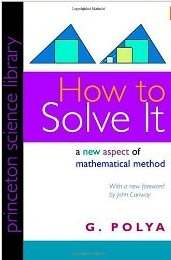
Pólya was one of the most influential mathematicians of the twentieth century. He made important contributions to a great variety of mathematical research: from complex analysis to mathematical physics, number theory, probability, geometry, astronomy, and combinatorics. He was also an extraordinary teacher--he taught until he was ninety--and maintained a strong interest in pedagogical matters throughout his long career. In addition to How to Solve It, he published a two-volume work on the topic of problem solving, Mathematics of Plausible Reasoning, also with Princeton.
Pólya is one of the most frequently quoted mathematicians, and the following statements from How to Solve It make clear why: "My method to overcome a difficulty is to go around it." "Geometry is the science of correct reasoning on incorrect figures." "In order to solve this differential equation you look at it till a solution occurs to you."
In this best-selling classic, George Pólya revealed how the mathematical method of demonstrating a proof or finding an unknown can be of help in attacking any problem that can be "reasoned" out--from building a bridge to winning a game of anagrams. Generations of readers have relished Pólya's deft instructions on stripping away irrelevancies and going straight to the heart of a problem. How to Solve It popularized heuristics, the art and science of discovery and invention. It has been in print continuously since 1945 and has been translated into twenty-three different languages.
Summary taken from G. Pólya, "How to Solve It", 2nd ed., Princeton University Press, 1957, ISBN 0-691-08097-6.
- UNDERSTANDING THE PROBLEM
- First. You have to understand the problem.
- What is the unknown? What are the data? What is the condition?
- Is it possible to satisfy the condition? Is the condition sufficient to determine the unknown? Or is it insufficient? Or redundant? Or contradictory?
- Draw a figure. Introduce suitable notation.
- Separate the various parts of the condition. Can you write them down?
- DEVISING A PLAN
- Second. Find the connection between the data and the unknown. You may be obliged to consider auxiliary problems if an immediate connection cannot be found. You should obtain eventually a plan of the solution.
- Have you seen it before? Or have you seen the same problem in a slightly different form?
- Do you know a related problem? Do you know a theorem that could be useful?
- Look at the unknown! And try to think of a familiar problem having the same or a similar unknown.
- Here is a problem related to yours and solved before. Could you use it? Could you use its result? Could you use its method? Should you introduce some auxiliary element in order to make its use possible?
- Could you restate the problem? Could you restate it still differently? Go back to definitions.
- If you cannot solve the proposed problem try to solve first some related problem. Could you imagine a more accessible related problem? A more general problem? A more special problem? An analogous problem? Could you solve a part of the problem? Keep only a part of the condition, drop the other part; how far is the unknown then determined, how can it vary? Could you derive something useful from the data? Could you think of other data appropriate to determine the unknown? Could you change the unknown or data, or both if necessary, so that the new unknown and the new data are nearer to each other?
- Did you use all the data? Did you use the whole condition? Have you taken into account all essential notions involved in the problem?
- CARRYING OUT THE PLAN
- Third. Carry out your plan.
- Carrying out your plan of the solution, check each step. Can you see clearly that the step is correct? Can you prove that it is correct?
- Looking Back
- Fourth. Examine the solution obtained.
- Can you check the result? Can you check the argument?
- Can you derive the solution differently? Can you see it at a glance?
- Can you use the result, or the method, for some other problem?