|
Classical
bubble nucleation theory, originally proposed by W. Gibbs assumes the
formation of the critical size bubble. This theory fails to predict the
amount of decompression for gaseous bubble formation in water-gas solutions.
It also fails to predict the tensile strength of liquids. In addition, the
classical theory gives no information about the evaporation intensity at the
superheat limit. Using
a new surface energy for the formation of the critical cluster(Molecular
Cluster Model), models for the gas bubble formation in gas-liquid solution[1]
and for the vapor bubble formation within a liquid under tension[2,3] were
proposed. Our cluster model for bubble nucleation can descripe correctly the
evaporation phenomena at the superheat limit[3]. How a critical cluster grows
to become a critical size bubble in gas-liquid solutions was also
theorized[4,5]. The cluster model of bubble nucleation may be applied to CO
bubble formation in iron-melt system characterized with high surface tension
and low vapor pressure[6] and the bubble formation on a cavity free
surface[7,8,9,10]. Recently the superheat limit of hydrocarbons and their
mixtures were measured precisely by using the droplet explosion technique
with visualization. The dynamic behavior of the bubble formed from the fully
evaporated droplet at its superheat limit was also investigated by measuring
the far field pressure signal from the bubble [11]. Recently we reformulated
the cluster model for the bubble formation due to dissolved gas molecules and
activated vapor molecules in a unified way [12]. Thermal as well as quantum
nucleation of bubbles and the cross-over from thermal to quantum regime in
liquid helium under negative pressure near the absolute zero temperature was
investigated by using the molecular cluster model based as the [1] Ho-Young Kwak, R.L. Panton, "Gas bubble formation in non-equillibrum water-gas solutions," Journal of Chemical Physics. Vol. 78. pp.5795-5799, 1983. [2] Ho-Young Kwak, R.L. Panton, "Tensile strength of simple liquids predicted by a model of molecular interactions," Journal of Physics, D, Applied Physics, Vol. 18, pp. 647-659, 1985. [3] Ho-Young Kwak, Sangbum Lee,"Homogeneous bubble nucleation predicted by a molecular interaction model," ASME Journal of Heat Transfer, Vol.113, pp. 714-721, 1991. [4] Ho-Young Kwak, "Homogeneous bubble nucleations," Applied Mechanics Review, Vol. 43, pp.164-165, 1990. [5] Ho-Young Kwak, Yong W. Kim, "Homogeneous nucleation and macroscopic growth of gas bubble in the organic solutions," International Journal of Heat Mass Transfer, Vol. 41, pp. 757-767, 1998. [6] Ho-Young Kwak, Si-Doek Oh, "A model of homogeneous bubble nucleation of CO bubble in Fe-C-O melts," Journal of Colloid and Interface Science, Vol. 198, pp.113-118, 1998. [7] Si-Doek Oh, Sam-Sun Seung, Ho-Young Kwak, " A model of bubble nucleation on a micro line heater," ASME Journal of Heat Transfer, Vol. 121, pp. 220-225, 1999. [8] Jung-Yeop Lee, Hong-Chul Park, Jung-Yeul Jung, and Ho-Young Kwak, "Bubble nucleation on micro line heaters," ASME Journal of Heat Transfer, Vol. 121, pp. 687-692, 2003. [9] Jung-Yeul Jung, Jung-Yeop Lee, Hong-Chul Park, and Ho-Young Kwak, "Bubble nucleation on micro heaters inder steady or finite pulse of voltage input," International Journal of Heat and Mass Transfer, Vol. 46, pp. 3897-3907, 2003. [10] Jung-Yeul Jung and Ho-Young Kwak, "Bubble nucleation and behavior on micro square heaters," Nanoscale and Microscale Thermophysical Engineering, Vol. 10, pp. 95-107, 2006. (featured on the issue cover) [11] Hong-Chul Park, Ki-Taek Byun, and Ho-Young Kwak, "Explosion boiling of liquid droplets at their superheat limits," Chemical Engineering Science, Vol. 60, pp. 1809-1821, 2005. [12] Ho-Young Kwak, and Si-Doek Oh, "Gas-vapor bubble nucleation; An unified approach," J. of Colloid and Interface Science, Vol. 278, pp. 436-446, 2004. [13] Ho-Young Kwak, Jung-Yeul Jung and Jae-Ho Hong, "Quantum nucleation of bubbles in liquid heliums," J. Phys. Soc. Jpn., Vol. 71, pp. 2186-2191, 2002. [14] Ki-Taek Byun, and Ho-Young Kwak, "A model of laser-induced cavitation," Jpn. J. Appl. Phys., Vol. 43, pp. 621-630, 2004. [15] Seong Lin Karng, Ki Young Kim, and Ho-Young Kwak, "Bubble nucleation and growth in polymer solutions," Polymer Engineering and Science, Vol. 44, pp. 1890-1899, 2004. [16] Ki Young Kim, Sung Lin Kang, and Ho-Young Kwak, "Generationof microcellular foams by supercritical carbond dioxide in a PMMA compound," International Polymer Processing, Vol. 23, pp. 8-16, 2008. [17] Jung-Yeul Jung and Ho-Young Kwak, "Fabrication and testing of bubble-powered micropumps using imbedded microheater," Microfluidics and Nanofluidics, Vol. 3, pp. 161-169, 2007. [18] Ki-Taek Byun, Ho-Young Kwak, and Sarng Woo Karng, "Bubble evolution and radiation mechanism for laser-induced collapsing bubble in water," Jpn. J. Appl. Phys., Vol. 43, pp. 6364-6370, 2004. [19] Ho-Young Kwak, Bubbles: Homogeneous nucleation, in Encyclopedia of Surface and Colloid Science, 2nd Edition, pp. 1048-1071, CRC Press, 2006.
Understanding of the behavior of bubble inside liquid is not a simple problem. The full hydrodynamic problem for the bubble motion involves solving 3-D Navier-Stokes equations inside and outside the bubble, coupled with equations of heat and mass transfers at the bubble wall. We have solved this problem without massive computational work! A breakthrough came by finding the analytical solution of the mass and momentum equations in spherical symmetry [20]. The conservation equations in spherical symmetry are given as
where r
is the distance from center,
where It has been found that there always exists a mismatch between the natural frequency of an oscillator (bubble) and the characteristic frequency of the applied ultrasound, so that a proper choice of time scale of the driving force is crucial for the calculation of the bubble behavier under ultrasound [27,28]. It has also been found experimentally that the upscaling of SBSL cannot be achieved at low frequencies of ultrasound due to such mismatch [29]. An artificial resonance may occur in the course of numerical evaluation of the equation for bubble motion under ultrasound if the bubble motion is forced to be in phase with the characteristic frequency of the driving force. Two time normalization method [27] was introduced to avoid the artificial resonance. Of course the two time normalization method introduced by us is a physical approximation which represents lagging behavior of bubble motion under ultrasound. Such relaxational motion of bubble, which is typical for nonlinear oscillators [30], turns out to be due to the combined effect of surface tension and viscosity of liquid. This method enables to explain why a sonoluminescing air bubble can be maintained at partial pressure of about 0.03~0.14 atm [31] and why the sonoluminescing air bubble can be stable at the driving pressure of 1.45 atm [32]. Recently, our theory predicts that extremely high temperature above million degree might be achieved from a submicron sonoluminescing gas bubble driven at 1 MHz [33]. This happens because the submicron bubble driven at MHz frequency can be stable even at higher driving pressure above 10 atm [32]. Even our theoretical model predicts correctly the nonlinear behavior of bubble in sulfuric acid solutions, which shows two states of bubble motion [34] and the characteristics of a sonoluminescing gas bubble such as the peak pressure and temperature and the flash width [35] in those solutions. Our theory will be used as a tool for optimum design of sonochemical reactors. [36] Exact solution of the cosmological fluid equations for Newtonian stars, which yields many fruitful results such as stellar stability, spherical oscillation and gravitational collapse [37] was obtained by using the linear velocity profile given in Eq. 4. The velocity profile obtained shows homologous character of the gases inside the sphere: every mass point during the collapse or expansion may be traced back to a single point. Furthermore, the exact solution yields to calculate central densities, pressures and temperatures of the Newtonian stars such as the Sun, Jupiter and the Saturn [38]. Our calculation results may be applicable to the formation of protostars. Experimental works on the single bubble sonoluminescence(SBSL) have also been done at PCL. It has been found that a selective bifurcation instead of period doubling occurs when the driving pressure is increased and the bubble gains extreme stability (SL state) after the cascade occurrence of such bifurcation [39]. Accurate measurement of the radius of a sonoluminescing gas bubble by light scattering method and direct imaging technique was tried [40] by using the remarkable stability of sonoluminescing gas bubble having the same shape variation sequence in every oscillation cycle and having only 50 ps jitter in the time flashes. Such SBSL characteristics enable to measure the bubble radius by the light scattering method and direct imaging tenique sequentially. The spectrum from SBSL was measured and the observed results were compared with the results by the theory proposed [21,23]. Calculated and experimental results yield common spectral behavior in the visible region : the spectral radiance shows power-law dependence on wavelength with an exponent of -2.5 [41]. Application of sonoluminescence phenomena such as possibility of bubble fusion and the chemical reaction enhanced by multibubble sonoluminescence are underway. For example, degradation of Methylene blue, a typical textile dyestuffs in aqueous solution was examined for the first time at the multibubble sonoluminescence (MBSL) condition [42]. At the optimum condition of MBSL, the solution was degradated completely. Recently, uniform coating on CdS particles on TiO2 nanoparticles[44] was succeeded through a one pot reaction under MBSL condition. Zinc oxide(ZnO) and ZnO-coated tintanium nanoparticles were synthesized in various alcohol solution[45] at the MBSL condition. Furthermore, Li4Ti5O12(LTO), a powerful anode material for all kids of rechargeable lithium batteries was systhesized by heating the LiOH coated TiO2 nanoparticles prepared at the MBSL condition[46]. Recently molecular dynamics simulation for the sonoluminescing gas bubble [45] with ten million molecules is in progress with supercomputer facility at KISTI (Korea Institute of Science and Technology Information), Daejon, Korea. An appropriate boundary condition at the bubble wall was found to be one of important factor to simulate the sonoluminescing bubble by molecular dynamics. [46] [20] Ho-Young Kwak and Hyup Yang, "An aspect of sonoluminescence from hydrodynamic theory," Journal of Physical Society of Japan, Vol. 64, pp. 1980-1992, 1995. [21] Ho-Young Kwak and Jung Hee Na, "Hydrodynamic solutions for a sonoluminescing gas bubble," Physical Review Letters, Vol. 77, pp. 4454-4475, 1996. [22] Ho-Young Kwak, Si-Doek Oh and Cheon-Ho Park, "Bubble dynamics for the evolving bubble formed from the droplet at the superheat limit," International Journal of Heat Mass Transfer, Vol. 38, pp. 1709-1718, 1995. [23] Ho-Young Kwak and Jung Hee Na, Physical process for single bubble sonoluminescence," Journal of Physical Society of Japan, Vol. 66, pp. 1101-1110, 1997. [24] Yoon-Pyo Lee, Sarng-Woo Karng, Jin-Seok Jeon and Ho-Young Kwak, "Shock pulse from a sonoluminesceing gas bubble," Journal of Physical Society of Japan, Vol. 66, pp. 2537-2540, 1997. [25] Sarng Woo Karng, Yoon Pyo Lee, Ki Young Kim, and Ho-Young Kwak, "Implosion mechanism for a sonoluminescing gas bubble," Journal of the Korean Physical Society, Vol. 43, pp. 135-144, 2003. [26] Ho-Young Kwak, Yoon-Pyo Lee and Sarng-Woo Karng, Pressure wave propagation inside a sonoluminescing gas bubble," Journal of Physical Society of Japan, Vol. 68, pp. 705-708, 1999. [27] Ho-Young Kwak, Joong-Yeob Lee and Sarng Woo Karng, "Bubble dynamics for single bubble sonoluminescence," Journal of Physical Society of Japan, Vol.70, pp.2909-2917, 2001. [28] Sarng Woo Karng and Ho-Young Kwak, "Relaxation behavior of microbubbles in ultrasonic field," Japanese Journal of Applied Physics, Vol. 45, pp. 317-322, 2006. [29] Jin-Seok Jeon, Joong-Yeob Lee and Ho-Young Kwak, "Possibility of upscaling for single bubble sonoluminescence at a low driving frequency", Journal of Physical Society of Japan, Vol.72, pp. 509-515, 2003. [30] Sarng Woo Karng, Ki Young Kim, and Ho-Young Kwak, "Lagging motion of forced nonlinear oscillators," Journal of Sound and Vibration, Vol. 287, pp. 117-128, 2005. [31] Jung-Hee Na, Gi-Taek Byun, and Ho-Young Kwak, 'Diffusive stability for a sonoluminescing gas bubble," Journal of the Korean Physical Society, Vol. 42, pp. 143-152, 2003. [32] Ho-Young Kwak, Sarng-Woo Karng and Yoo-Pyo Lee, "Rayleigh-Taylor instability on sonoluminescing gas bubble," Journal of the Korean Physical Society, Vol. 46, pp. 951-962, 2005. [33] Ki-Taek Byun, Sarng Woo Karng, Ki Young Kim and Ho-Young Kwak, "Sonoluminescence characteristics from micron and submicron size bubbles," Journal of the Korean Physical Society, Vol. 47, No. 6, 2005. [34] Ki Young Kim and Ho-Young Kwak, “Prediction of bubble behavior in sulfuric acid solutions by a set of solutions of Navier-Stokes equations,” Chemical Engineering Science, Vol. 62, pp. 2880-2889, 2007. [35] Ki Young Kim, Ki-Taek Byun and Ho-Young Kwak, “Characteristics of sonolunescing bubbles in aqueous solutions of sulfuric acid,” Journal of Physical Society of Japan, Vol. 75, No. 11, 2006. [36] Ki Young Kim, Ki-Taek Byun, and Ho-Young Kwak, “Temperature and pressure fields due to collapsing bubble under ultrasound," Chemical Engineering Journal, Vol. 131/132, pp. 125-135, 2007. [37] Jung Whan Jun and Ho-Young Kwak, "Gravitational collapse of Newtonian stars", International Journal of Modern Physics D, Vol. 9, pp. 35-42, 2000. [38] Ho-Young Kwak and Jung Whan Jun, "Hydrodynamics and thermodynamics of Newtonian stars," Geophys. Astrophys. Fluid Dynamics, pp. 1-14. 2003. [39] Byung-Rock Kim, Jin Seok Jeon and Ho-Young Kwak, "Stability and selective bifurcation for a gas bubble oscillating under ultrasound", Journal of Physical Society of Japan, Vol. 68, pp. 1197-1204, 1999. [40] Jin-Seok Jeon, Ik-Jun Yang, Sarng Woo Karng and Ho-Young Kwak, "Radius measurement of a microbubble oscilliating under ultrasound", Japanese Journal of Applied Physics, Vol.39, pp. 1124-1127, 2000 [41] Jin-Seok Jeon, Ik-Jun Yang, Jung Hee Na and Ho-Young Kwak, "Radiation mechanism for a single bubble sonoluminescence," Journal of Physical Society of Japan, Vol. 69, pp. 112-119, 2000. [42] Ki-Taek Byun and Ho-Young Kwak, "Degradation of Methylene blue under multibubble sonoluminescence," Journal of Photochemistry and Photobiology, Vol. 175, pp. 45-50, 2005. [43] Seong Soo Lee, Kook Won Seo, Seok Hwan Yoon, Il-Wun Shim, Ki-Taek Byun and Ho-Young Kwak, "CdS coating on TiO2 nanoparticles under multibubble sonoluminescence condition," Bulletin of the Korean Chemical Society, Vol. 26, pp. 1579-1581, 2005. [44] Ki-Taek Byun, Kook Won Seo, Il-Wun Shim, and Ho-Young Kwak," Syntheses of ZnO and ZnO-coated nanoparticles in various alcohol solutions at multibubble sonoluminescence (MBSL) condition, Chemical Engineering Journal, Vol. 132, pp. 125-135, 2007. [45] Seung Soo Lee, Ki-Taek Byun, Jong Pil Park, Sin Kyu Kim, Ho-Young Kwak, and Il-Wun Shim, "Preparation of Li4Ti5O12 nanoparticles by a simple sonochemical method," Dalton Transations, Vol. 37, pp. 4182-4184, 2007. [46] Ki Young Kim and Ho-Young Kwak, and Jong Hyun Kim, “Molecular dynamics simulation of collapsing phase for asonoluminescing gas bubble in sulfuric acid solutions : A comparative study with theoretical results”, Journal of Physical Society of Japan, Vol. 76, Paper #024301, 2007. [47] Ki Young Kim, Chansoo Im, Ho-Young Kwak, and Jong Hyun Kim, "Validation of molecular dynamics simulation for a collapsing gas bubble," Will be published in Molrecular Physics, 2008.
|



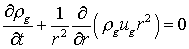 (1)
(1)
 is the gas density
  is the gas velocity which obeys
 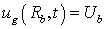 . A
set of solutions satisfying Eqs. (1) and (2) are [21]
. A
set of solutions satisfying Eqs. (1) and (2) are [21] (3)
(3) (4)
(4)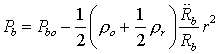 (5)
(5)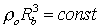 and
and  .
.


