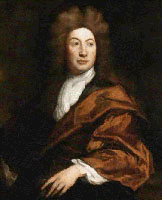
JOHN DRYDEN
[1631-1700]
John Dryden was a poet, dramatist, satirist, translator, and miscellaneous writer: one of the chief founder of modern English prose, the first great English critic, the most representative writer of Restoration, and the greatest literary man of his time. Dryden was born at Aldwinkle, in Northamptonshire. Although his parents seem to have sided with Parliament against the king, there is no evidence that the poet grew up in a strict Puritan family. His father, a country gentleman of moderate fortune, gave his son a gentleman's education at Westminter School (c. 1644-1650), under the renowned Dr. Richard Busby, who used the rod as a pedagogical aid in imparting a sound knowledge of the learned languages and literatures to his charges. From Westminter, Dryden went to Trinity College, Cambridge (1650-1654), where he took his A. B. in 1654. Accepting the antimonarchial principles of his family, he probably held a minor post in Cromwell's government. Dryden admired Cromwell, and wrote his first important and impressive poem, Heroic Stanzas (1659), to commemorate the death of Cromwell. In the next year, when the monarchy was restored, Dryden hailed the coronation of Charles II with the fulsome1) Astraea Redux, which he followed with a lavish tribute to the "modern Augustus" entitled A Panegyric2) on the Restoration. Years later, however, Dryden's political and religious enemies taunted him with this sudden change of position, as if he had been a political turncoat,3) ready to change sides whenever he could serve his own interests. The change has often been repeated, but it is both malicious and stupid: as Dr. Johnson long ago said, "if he changed, he changed with the nation," for in 1660 most Englishmen enthusiastically welcomed the Restoration. During the rest of his life Dryden was to remain entirely loyal to Charles and to his successor James II.
In his early thirties Dryden married Lady Elizabeth Howard (1663), eldest daughter of the Earl of Berkshire, who bore him three sons and who survived him until 1710. His wife was somewhat his senior. The marriage was uncongenial and, although there is no evidence of a separation, Dryden scarcely ever mentioned marriage without attacking it. Even before his wife's death he wrote an epitaph that is concise and unforgettably savage. Some fourteen years after his schooling at Cambridge, he was granted M. A. degree from his alma mater in 1668. Around this time Dryden was designated Poet Laureate (1668), and his appointment was confirmed when he received a patent as both Poet Laureate and Historiographer Royal (1670). Dryden joined the Roman Catholic Church in 1685. He prepared The Hind and the Panther as an argument for Roman Catholicism, but the public was tired of him and exasperated with the Stuarts. James fled to France. With the Revolution of 1688 Dryden, neither abjuring4) Catholicism nor pledging allegiance to William III, lost his office and pension as Laureate and Historiographer Royal (1688). After Dryden, Thomas Shadwell, the very poet he had attacked in his mock-heroic episode Mac Flecknoe, took the laureateship. Therefore, he was obliged to betake himself again to the stage as the most lucrative5) department of literature, and to undertake various jobs of translation for the publisher, Jacob Tonson. His production in these years added much to his fame. During these last years Dryden lived in London. The coffee-house of that day was the chief place of resort for literary men, where the wits gathered for exchange of courtesies or for combat. And there their admirers or patrons met the literary men, and thence went forth the criticism that made or marred the fortunes of rising men as surely as do the reviews in a modern literary journal. Dryden frequented Will's coffee-house, where he was as much a monarch as Ben Jonson had been at the Mermaid, or as, a century later, Samuel Johnson was at meetings of the Literary Club. Dryden died of gangrene and was buried in the yard of the College of Physicians; but a few days afterwards was disinterred and buried in Westminster Abbey, in Chaucer's grave. A few years later a monument to him was erected there by Lord Mulgrave.
Dryden's poems have the qualities of his plays―some middling songs and unspontaneous lyrics, careful and melodic versification, and lack of poetic expression of the different emotions. Despite touches of false ornament and operatic banality,6) his odes are splendid. As a verse-satirist and character-writer he is unequalled, for he is consummately compact of thought and even musical, devastating7) in portraiture, and so superb in handling the heroic couplet that it became established as the fashion for satiric poetry. Taine describes his poetic genius as "pre-eminently robust8) and unromantic"; Gosse describes him as "the strongest poet of the age of prose." His Annus Mirabilis (1667) is a poem which is written in iambic pentameter quatrains with eloquent tone. It treats primarily of two events of the "Wonderful Year" of the preceding year 1666; the first two thirds describe the engagement with the Dutch fleet culminating in the naval victory over the Dutch on July 25; the last third treats of the Great Fire in London, September 2 to 7. His Absalom and Achitophel (I, 1681; II, 1682) is an allegorical satire in heroic couplets on the Whig attempt of the Earl of Shaftesbury to set up James, Duke of Monmouth, a Protestant, in place of James, Duke of York, a Roman Catholic, as the successor of Charles II. It has been called the greatest political verse satire in the language; with energetic presentation of the political principles of both sides, dignified but damaging characterization, deadly wit, blazing diction, devastating invective. As the backbone of this allegorical verse satire, Dryden adapts the Biblical story (II Samuel, xiii-xviii) of Absalom's rebellion against King David to the political situation. In fact, in the biblical story of the revolt of Absalom against King David, Dryden found an apt parallel to existing circumstance in England in his day.
1. fulsome: (of flattery) so much as to be unpleasant.
2. panegyric: compliment; eulogy (=a speech or piece of writing to praise a person or thing).
3. turncoat: betrayer; crawfish; traitor.
4. abjure: declare to give up (one's right, faith, demand, nationality, etc.).
5. lucrative: profitable; producing wealth or profit.
6. banality: commonplaceness; platitude; threadbareness.
7. devastating: (1) fine; excellent; superb. (2) severe; bitter; incisive; scathing.
8. robust: strong; firm.